Sunday, February 12, 2017

Latter-day Stained Glass: Part 2 - First Vision Stained Glass Depictions

Note: This is a part of a series on the history of the use of stained glass in LDS meetinghouses. To see a full list of the posts in this series, click here.

Of all the events in the Church, perhaps the one most commonly depicted in stained glass and murals is the First Vision. At least 7 depictions of this sacred event were made into stained glass and placed in meetinghouses for local members to enjoy. They end up providing an insight into how stained glass was used in early (and more modern) Mormon chapels.

The first instance of stained glass depicting this event was ordered in 1892 by the First Presidency, seeking a suitable feature for the Holy of Holies in the Salt Lake Temple. The Church gave very specific instructions on how the event should be depicted (for example, emphasizing that the Father and the Son were in exact likeness of each other, and that they did not have wings).


To my knowledge, the photo below, printed in the Spring 1969 edition of BYU Studies, is the only color print of this stained glass window. It is a fitting addition to the Holy of Holies.


Three copies of this stained glass window were ordered in the next few years. They were not exact copies; they each had their own style and shape. In 1907, the Salt Lake Seventeenth Ward ordered a copy of the window. That window still stands in the chapel that replaced the original one. You'll notice that the characters are quite similar in their posture to the original window, although the window itself is much bigger and the scene, grander.


And just a year later, in 1908, the Second Ward requested a copy for their chapel. Again, the figures are almost exactly the same, albeit with different positions and a different background:


In that same year, the new Liberty Ward, unable to meet the financial requirements of such a large window, ordered a small version to grace their largest stained glass window. This one used an entirely different template; a different artist was likely used to compose this scene.


Three years later, in 1911, the Brigham City 3rd Ward requested their own copy of the first vision stained glass. This one also used a different template from its predecessors:


In 1913, when the Adams Ward was constructed in Los Angeles, the ward ordered their own stained glass depiction of the event. This template matches the one that was installed in the Liberty Ward; while the Liberty Ward's building was constructed first, it could be that the Adams Ward's window was first ordered, and the Liberty Ward then copied their template (at a much smaller scale). The beautiful window hung in the chapel until 1959, when it was razed; it is now in the Church History Museum.


Apparently, somewhere around this same time, the LDS meetinghouse in or near Brawley, California also got their own small depiction of the first vision.


This pictures are pathetically small, but I found it online. The stained glass is now in the primary room. It looks like the figures of the Father and Christ match those of the ones in the Adams ward, although Joseph looks different. I'm still trying to find out the history behind this window.

Years later, in 1930, when the San Bernardino ward was building its own chapel, another stained glass depiction was ordered.

This one is quite unique because of how different the Father and the Son appear. Apparently, upon surveying the window, President Heber J. Grant was critical; saying that "the Father and the Son should be made to look alike." In this window, they do not resemble each other.

This window continued to hang in the San Bernardino chapel, even after it was sold 1960. In 1978, after repeated requests, the Church was allowed to buy back the window. It was hung in another nearby chapel until the Redlands temple was dedicated in 2003, when it was moved to the temple recommend desk, where it is currently located.


Even modern stained glass has sought to capture the beauty of this event: the Fairfield, California stake was able to fashion their own rose window that would fit at the front of a chapel they were planning on purchasing from another, non-LDS congregation. The First Vision was prominently featured in the center of the window, while other, smaller windows surrounded it:


There are certainly other windows depicting the First Vision, although the status of some of these windows are unknown. President Dieter F. Uchtdorf has reminisced about his meetinghouse in Germany, which also had a stained glass depiction of the First Vision. The location of this window is now unknown.

These are all of the depictions of which I am aware. If there are any more out there, I'd love to hear about them! The most recent window was made for the Palmyra Temple, dedicated in 2000. It is housed in the lobby, along with clear windows that allow patrons to see the Sacred Grove outside.


Of course, the First Vision is quite unique to the LDS Church for its depiction in stained glass. Other windows were much more mainstream, depicting Christ and other traditional Christian symbols. This series will examine those relationships in future weeks; next week, we will examine the sources of stained glass and who enabled these windows to be made and installed.

Next Week: Part 3 - In Memoriam, In Glass: Donations of Stained Glass Windows

Thursday, February 9, 2017

Paris Tabernacle: Art Glass Window

Apparently, this window was ordered, assembled, and installed by James Collings, after he was told that the saints had no resources to make their own art glass window. It is at the back of the chapel, at the top of the door you enter to access the balcony.

Tuesday, February 7, 2017

Paris Tabernacle: Interior

This tabernacle is similar to the ones in Brigham City, St. George, or Logan, with its balcony on three sides and the focus on the rostrum and organ. However, it also has the feel of a cathedral due to its sheer size, the height of the ceiling and its curved shape (built by a shipbuilder, James Collings), and the detailed carvings and moldings.


This organ was installed in 1928.


A colorful art glass window is at the back. More pictures will be posted shortly.


Sunday, February 5, 2017

Latter-day Stained Glass: Part 1 - The Introduction and Early Use of Stained Glass

Note: This is a part of a series on the history of the use of stained glass in LDS meetinghouses. To see a full list of the posts in this series, click here.

The use of stained glass in the LDS Church has largely followed historical patterns, albeit with some modifications. A revival in Gothic architecture began in Europe in the early nineteenth century, leading to a renewed interest in stained glass. This interest spread quickly to America, and by the mid-1800s, the number of glass makers in the United States was growing quickly. Tiffany Studios, one of the largest producers of stained glass, would begin work in 1878.

In spite of the growing trend, no examples of stained glass could be found in the LDS Church until the latter end of the 1800s. Even after settling in Utah by mid-century, the Church did not have the means for such luxuries; furthermore, the relative isolation of the Great Basin made it extremely difficult to procure any type of glass. (Tours in St. George, Utah often stress the extreme difficulty the stains had in obtaining and transporting the clear glass panes that were used in the St. George Tabernacle and Temple, both built in the 1870s.)

St. George Tabernacle

Perhaps one of the earliest examples of LDS stained glass could be the original windows in the Millcreek Ward chapel; some sources indicate that the smaller windows on the sides (not the main ones depicting Christ as the Good Shepherd) were brought by wagon in 1867. However, the lack of documentation makes it difficult to verify and accurately date many windows.

Original windows in Millcreek Ward (Image Source: Church History Library)

Even with the arrival in the railroad in 1869, stained glass was not seen in earnest until the 1890s. The Salt Lake Temple had some beautiful panes installed. As for chapels, some of the earliest Mormon windows were placed in the Salt Lake Fourth Ward (in 1888; no longer standing) and the Assembly Hall (in 1893). 

Salt Lake Fourth Ward (Image Source: Church History Library)

Assembly Hall Windows
Other windows likely date from this period, but a lack of information leaves a lot of uncertainty. In some buildings, the stained glass windows would be installed afterward, and no exact source indicates when they were installed. In some cases, this leaves questions about whether the glass was installed when the building was first constructed, or whether it was installed at a later date. For example, the Coalville Tabernacle was built in 1883, and its windows were likely made soon afterward—however, the lack of documentation makes it difficult to know exactly when some windows were installed.


Another early example could be the Payson Second Ward’s windows; some sources indicate that the windows have stood along with the chapel since it was first built in 1896. However, it is also possible that the stained glass was installed in the early 1900s.


Another example of early stained glass is found in the Paris Tabernacle. Tour guides suggest that James Collings Sr., who helped construct the tabernacle with its distinctive ceiling, paid for the stained glass window himself. Wood was used to divide the colored glass instead of lead.


All told, there were probably only a handful of installations of stained glass in LDS meetinghouses in the 1800s. These windows tended to be very plain, reflecting the poverty of the saints and the difficulty in procuring detailed windows. However, the use of stained glass would pick up in the next decade; between 1900 and 1910 alone, there are at least 16 concrete examples of stained glass windows.

The Salt Lake Temple did receive stained glass windows when it was constructed in the 1890s. By the early 1900s, one of its windows would be copied and placed in a few other chapels. Our next post will study those windows and the different depictions of one of the most well-known events of the LDS Church: Joseph Smith’s First Vision.

Next Week: Part 2 - From Temples to Chapels: The First Vision in Stained Glass

Thursday, February 2, 2017

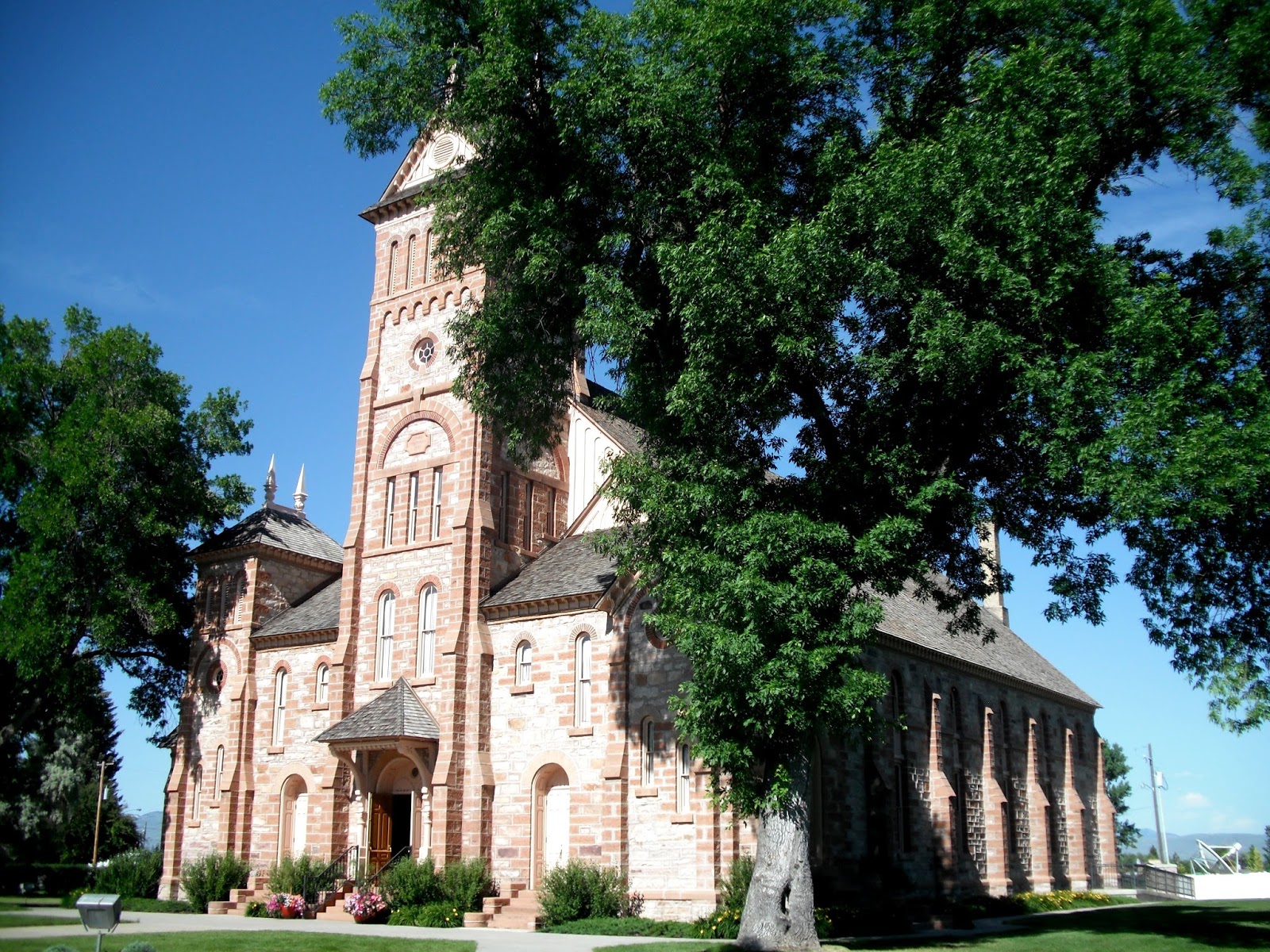
Paris Tabernacle

The tabernacle in Paris, Idaho (population: 500) is one of the greatest architectural treasures built by the LDS Church. It was designed by Joseph Young (the son of Brigham Young) and built from 1884-1888, dedicated in 1889 by Wilford Woodruff.


The building has also been meticulously preserved, most recently in 2005, when it underwent a huge restoration. It now serves as a place for stake conferences, community events, and tourists during the summer. There's a lot to see here!

Tuesday, January 31, 2017

Twenty-ninth Ward (Salt Lake): Stained Glass Detail

 The front of the 29th Ward had three beautiful stained glass windows: two smaller transom windows over the main entrances, and one large one between the two. These were at the back of the chapel, but since they were on the south side, they provided beautiful colored light to the members of the ward.

(Image Source: Church History Library)
By the early 1950s, the doors and their transom windows had been removed; instead, one main door was placed between the two.


Of course, now, all of the windows are gone. The large window was removed in a 1960 renovation; several of the pieces of glass were loose, and ward members felt that "repair would be too costly." A large frosted window was put in its place; predictably enough, this allowed too much light to enter and created a glare on the congregation. So it was covered with curtains.

It's disappointing that the stained glass was removed and that steps were not taken to preserve it. The current location of the windows is unknown; they may have been discarded, or someone may have taken possession of them, loose pieces notwithstanding. However, an artist did a painting of the window before it was removed:


It was a beautiful window.